
Replacing Manual Operations With an AI-Assisted Workflow Stack
Most operational drag does not come from a lack of effort. It comes from a tangle of disconnected steps: a spreadsheet that feeds a form that triggers an email that someone has to read, interpret, and re-enter somewhere else. The work gets done, but it gets done by people doing what software should be doing for them.
That is the problem we are built to remove.
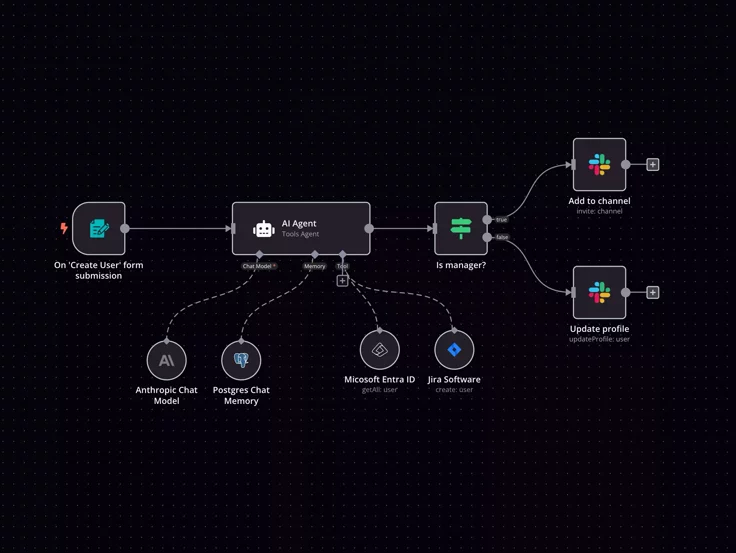
What we mean by AI integration
AI integration is not a chatbot bolted onto a website. It is the disciplined work of finding the points in an operation where judgment, routing, and repetition consume the most human hours, then engineering an integrated layer that handles them reliably. The goal is not novelty. The goal is a system that runs the same way every time, surfaces exceptions for a human to decide, and gets out of the way.
We treat automation as architecture, not as a feature. Before we automate a single step, we map the system as it actually behaves: where data enters, where it stalls, who touches it, and what breaks when volume rises. Only then do we decide what an AI layer should own and what a person should keep.
A representative engagement
In a recent engagement we assembled a four-person bench across AI engineering, systems architecture, and operations to consolidate a set of fragmented manual processes into a single, integrated workflow stack.
The starting state was familiar. Intake arrived through several channels. Records were keyed by hand into more than one system. Follow-up depended on whoever remembered to follow up. Reporting was a monthly reconstruction rather than a live picture.
The bench did three things in sequence. First, it unified intake so that every record entered through one structured path. Second, it built an AI-assisted routing and enrichment layer that classified each record, drafted the first response, and flagged anything that did not fit a known pattern. Third, it connected the stack to the systems the team already used, so adoption did not depend on people learning a new home for their work.
The result was not a team replaced. It was a team freed from the parts of the day that never required them in the first place.
What clients retain
When the engagement ends, you keep the system, the documentation, and the institutional knowledge of how it was built. There is no retainer holding the work hostage and no standing account that quietly expands. The workflow stack belongs to you, and your own people can run it.
Who this is for
This work fits organizations that have outgrown manual coordination but have not yet engineered their way out of it. If your team spends its best hours moving information between tools, copying the same data twice, or chasing status updates that a system should produce on its own, there is a stack waiting to be built.
We scope it, we ship it, and the team disbands when it is stable.
Ready to remove the manual layer?
We review every brief within five business days and return with a proposed team and engagement structure.